Batch cooking for beginners: cook one afternoon and eat well all week
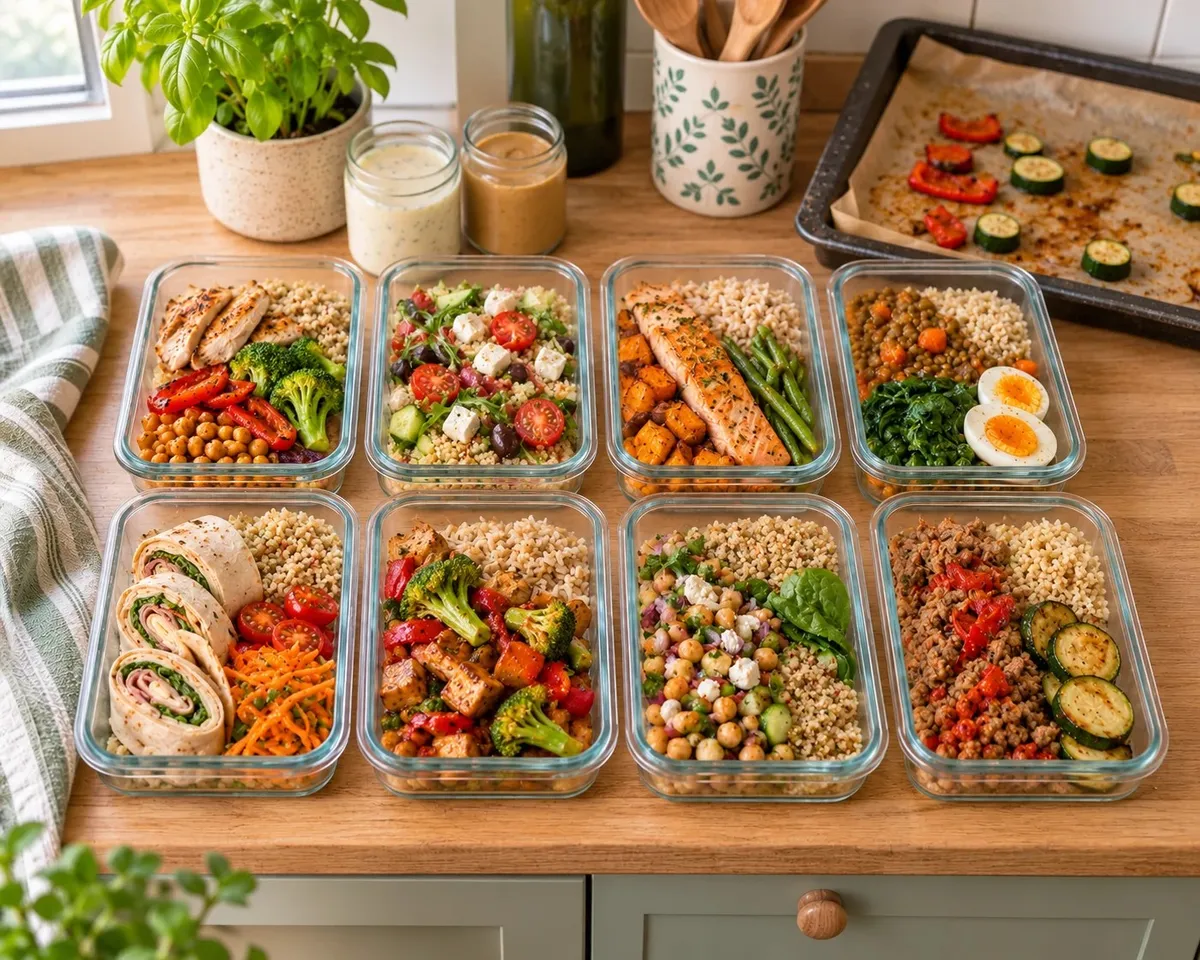
It's nine-thirty at night. You get home, open the fridge, and it asks the usual question: what's for dinner? The answer, far too often, is pasta with jarred tomato sauce or the delivery app.
Batch cooking swaps that question for a much more comfortable one: what do I have ready to put together? One afternoon a week you cook, and the rest of the days the food is already in the fridge. Tasty, balanced and cheap.
This guide is for anyone who has never cooked, or hardly ever. You don't need to be a chef. You need a system.
Free download: the “Build Your Week” planner (PDF) ↓
What batch cooking is (and what it isn't)
Batch cooking means cooking in batches: setting aside some time, on whichever day suits you best, to prepare the base of several days of meals. Put like that, it sounds like what your grandparents did with a big pot of stew. The difference is in the method.
It isn't cooking a giant pot of lentils and eating the same thing five days in a row. That works until Wednesday. On Thursday you discover that a person can hate lentils.
It is preparing pieces that combine with each other. With those pieces you put together a bowl on Monday, a wrap on Tuesday and a stir-fry on Wednesday: same ingredients, meals that look nothing alike.
The three styles
| Style | What it involves | Advantage | Drawback |
|---|---|---|---|
| Complete dishes | You cook 3 or 4 finished recipes and divide them into containers | Open, heat and eat | Less variety; you get tired of it sooner |
| Components | You prepare separate pieces and assemble each dish at the last minute | Maximum variety | You have to assemble each meal (2-3 minutes) |
| Hybrid | One or two complete dishes plus several components | The best of both | None worth mentioning |
If you're starting out, the hybrid is the one that best survives a real week: some days you don't have even three minutes, and other days you fancy something different.
The complete-container formula
Every complete dish has four pieces. If you have them prepared, putting together a meal takes two minutes:
Protein + Base + Vegetable + Sauce = complete container
- Protein: legumes, eggs, chicken, turkey, fish, tofu. It keeps you full.
- Base: rice, pasta, quinoa, couscous, potato, sweet potato, whole-grain bread. It gives you energy.
- Vegetable: roasted, steamed, raw or as a soup. It adds fiber, vitamins and volume.
- Sauce: the piece that makes everything taste different each day. Prepare at least two a week.
One batch, five different meals
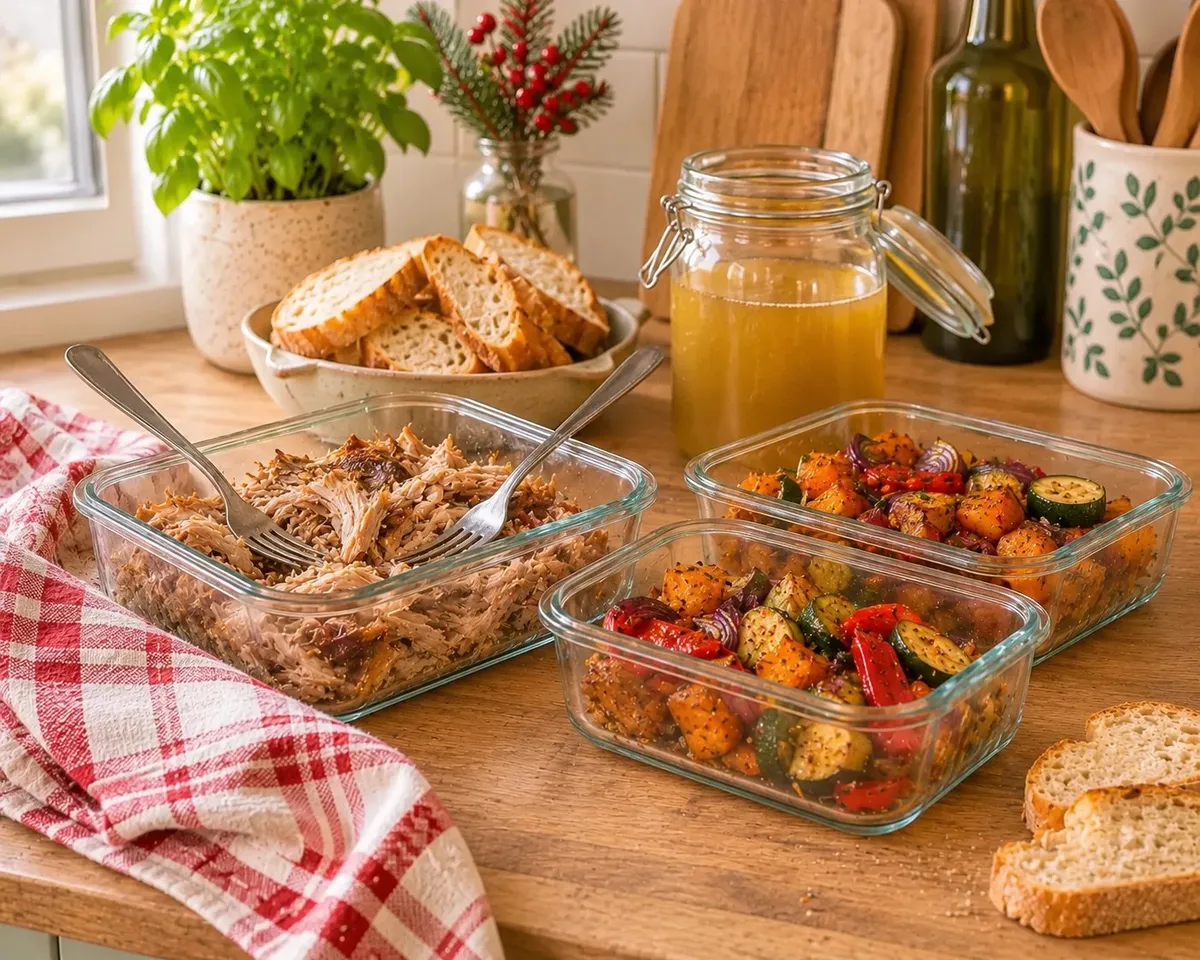
Imagine that in your session you've prepared shredded chicken, oven-baked chickpeas, roasted vegetables, brown rice and two sauces. During the week:
- Monday: bowl of rice, chicken, roasted vegetables and yogurt sauce.
- Tuesday: whole-wheat wrap with chicken, vegetables and hummus.
- Wednesday: warm salad with leafy greens, crunchy chickpeas, vegetables and vinaigrette.
- Thursday: stir-fry of vegetables and chicken with peanut sauce.
- Friday: omelet with whatever vegetables and chickpeas are left.
Your first session, step by step
A batch cooking session isn't about cooking five recipes one after another, but at the same time, taking advantage of the fact that the oven and the burners do the work on their own.
Before you start (10 minutes): wash whatever is waiting in the sink, take out all the ingredients and utensils, and heat the oven to 400 °F (200 °C). Chefs call it mise en place: everything in its place before you begin.
The golden sequence:
- Oven first. What takes longest and needs the least attention: roasted vegetables, chicken, sweet potato, chickpeas.
- Burners next. While the oven works, put the rice, legumes or eggs on to boil.
- Chop and prepare. While everything cooks, cut the raw vegetables and make the sauces.
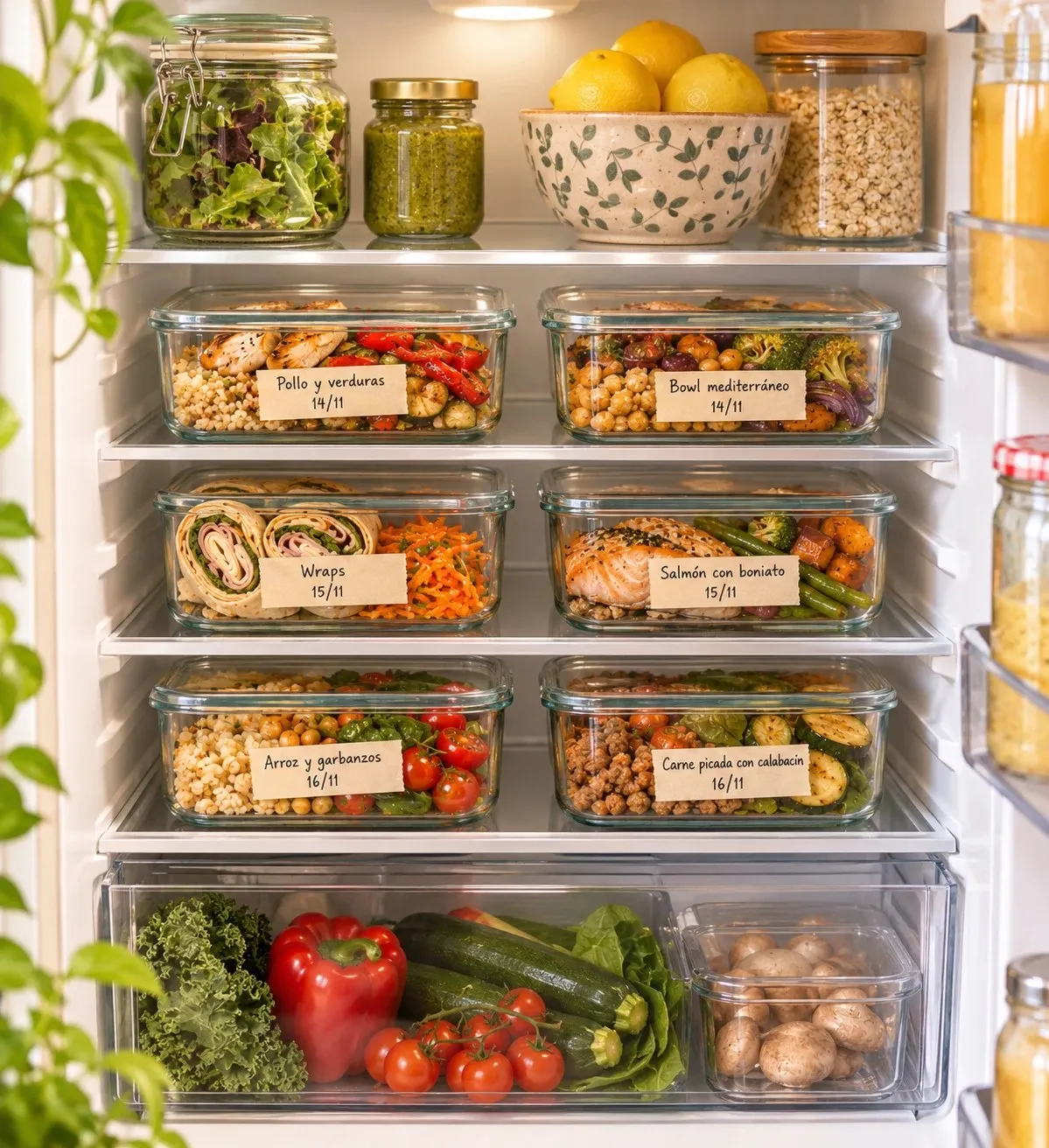
- Cool and pack. At the end, divide into containers, label and store.
And one trick that changes the experience: wash as you go. Every time you're waiting for something to cook, wash whatever you've finished using. You'll end up with an almost clean kitchen.
Timeline for your first time (90 minutes)
| Minute | What you do |
|---|---|
| 0-10 | Oven to 400 °F (200 °C). Take out the ingredients. Put water on to boil |
| 10-20 | Cut the vegetables for roasting and the chicken. Both trays into the oven |
| 20-25 | Rice or pasta into the boiling water. Set the timer |
| 25-45 | Meanwhile: boil the eggs, wash and dry the greens, make two sauces |
| 45-55 | Drain the rice and spread it on a tray so it cools quickly. Turn the oven trays |
| 55-70 | Take everything out of the oven. Shred the chicken. Peel the eggs. Wash what you've used |
| 70-90 | Divide into containers and label. Fridge for Monday to Wednesday, freezer for Thursday and Friday |
The first time it will take you longer. By the third week, you'll do it in an hour while listening to a podcast.
The day-3 rule
Cooked food won't last a whole week in the fridge. That's why batch cooking is always organized the same way:
- Days 1 to 3: in the fridge.
- Days 4 and 5: straight into the freezer as soon as it cools.
- The night of day 3: move what you'll eat on day 4 to the fridge.
Some foods have shorter limits, such as cooked rice and fish. We explain it with all the time limits in how long does cooked food last in the fridge?.
The seven first-time mistakes
- Cooking for an army. Start with 4 servings of each thing. If there's extra, freeze it.
- Making everything the same. If everything is roasted with paprika, by Wednesday it all tastes alike. Vary your techniques and, above all, your sauces.
- Forgetting the sauces. They're the piece that changes a dish the most for the least effort.
- Not labeling. What it is and what day it was cooked, always. Masking tape and a marker are enough.
- Choosing recipes that don't keep. Fried food, dressed leaves and pasta already mixed with sauce don't survive the fridge. Store the components separately and assemble when you serve.
- Starting without a plan. A session without a timeline takes twice as long.
- Leaving food to cool on the counter all afternoon. It's the most dangerous mistake: two hours outside the fridge at most.
What you need (and what you don't)
You don't need a magazine kitchen. With a frying pan, a medium pot with a lid, a baking tray, a good knife, a cutting board, a colander and 8-10 containers you can get started. If you only have a microwave, that works too: with a lidded container you can cook vegetables, potatoes, eggs and even fish.
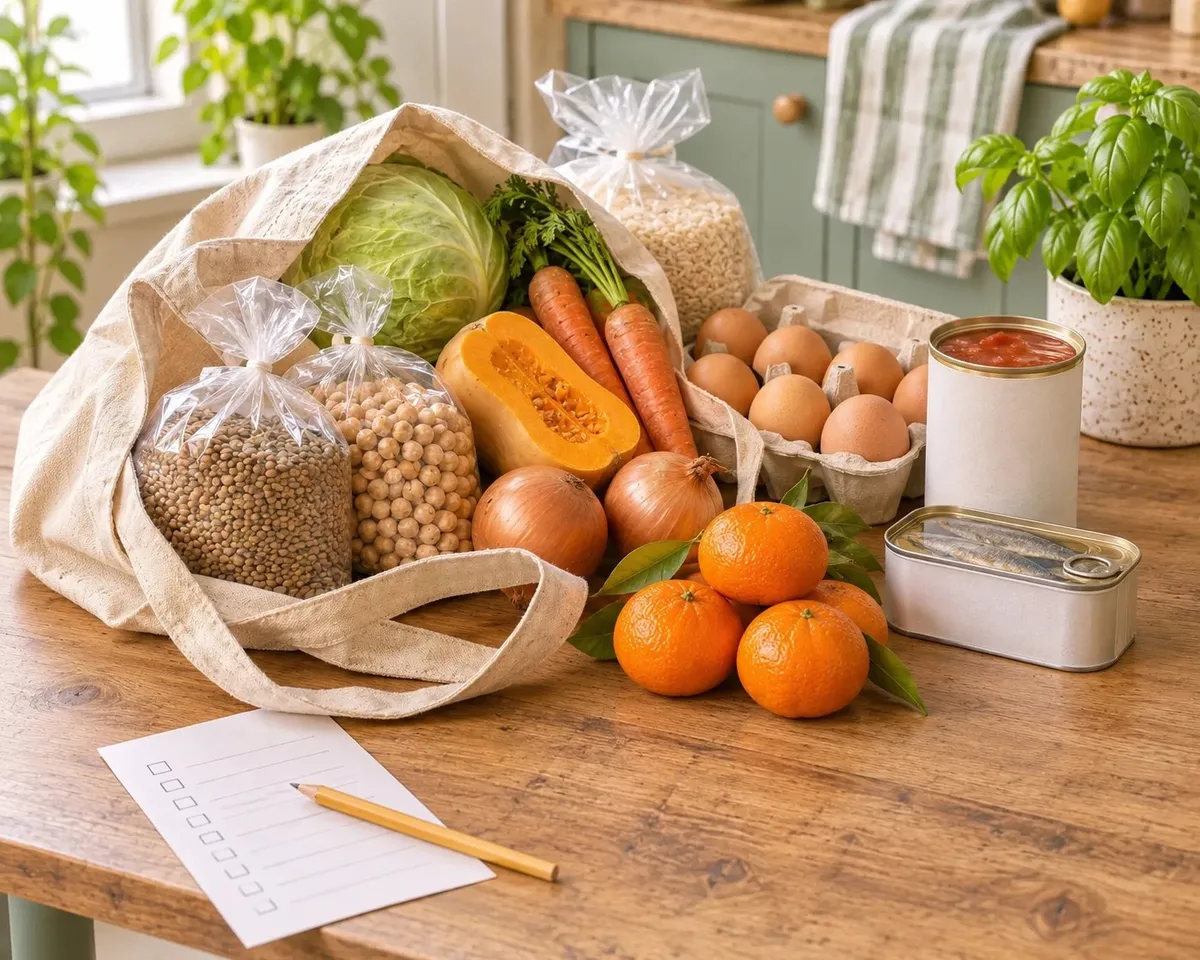
And before the session, the shopping. If you want to do it on a small budget, there's a complete list in a cheap grocery list for one week.
Free download: the “Build Your Week” planner
So you don't have to think from scratch, we're leaving you the book's planner: you choose your proteins, your base, your vegetables and your sauces, and note what you eat each day and where it comes from (fridge or freezer). Print it and stick it on the fridge.
Download the “Build Your Week” planner (PDF) ↓
Frequently asked questions
What is batch cooking?
It means cooking in batches: setting aside some time, usually one afternoon a week, to prepare the base of several days of meals. It isn't about making one giant pot of the same thing, but about preparing pieces (a protein, a base, vegetables and sauces) that you combine differently each day.
How long does batch cooking take?
The first session usually takes about two hours. With practice, by the third week, it comes down to an hour or an hour and a quarter to prepare Monday-to-Friday meals.
How many days does batch-cooked food last?
As a cautious rule, what you'll eat in the first three days goes in the fridge, and what's for days four and five goes straight into the freezer as soon as it cools. Cooked rice and fish have shorter limits: one or two days in the fridge.
Is batch cooking worth it if I live alone?
It's where it makes the most sense. You cook four servings of each piece, eat from the fridge for the first few days and freeze the rest. You save money and time, and you avoid ordering takeout because there's nothing ready.
Going further
Cut the Apron Strings is the batch-cooking book for anyone who has just moved into their first kitchen: food safety without drama, shopping on a small budget, sharing a fridge and a Plan B for when the week goes sideways. And if you're about to take the leap, run the numbers first with how much money do you need to move out?.
This article offers general guidelines for the general population and does not replace the advice of a doctor or a registered dietitian.