
Compound interest explained with numbers: why starting at 20 changes so much
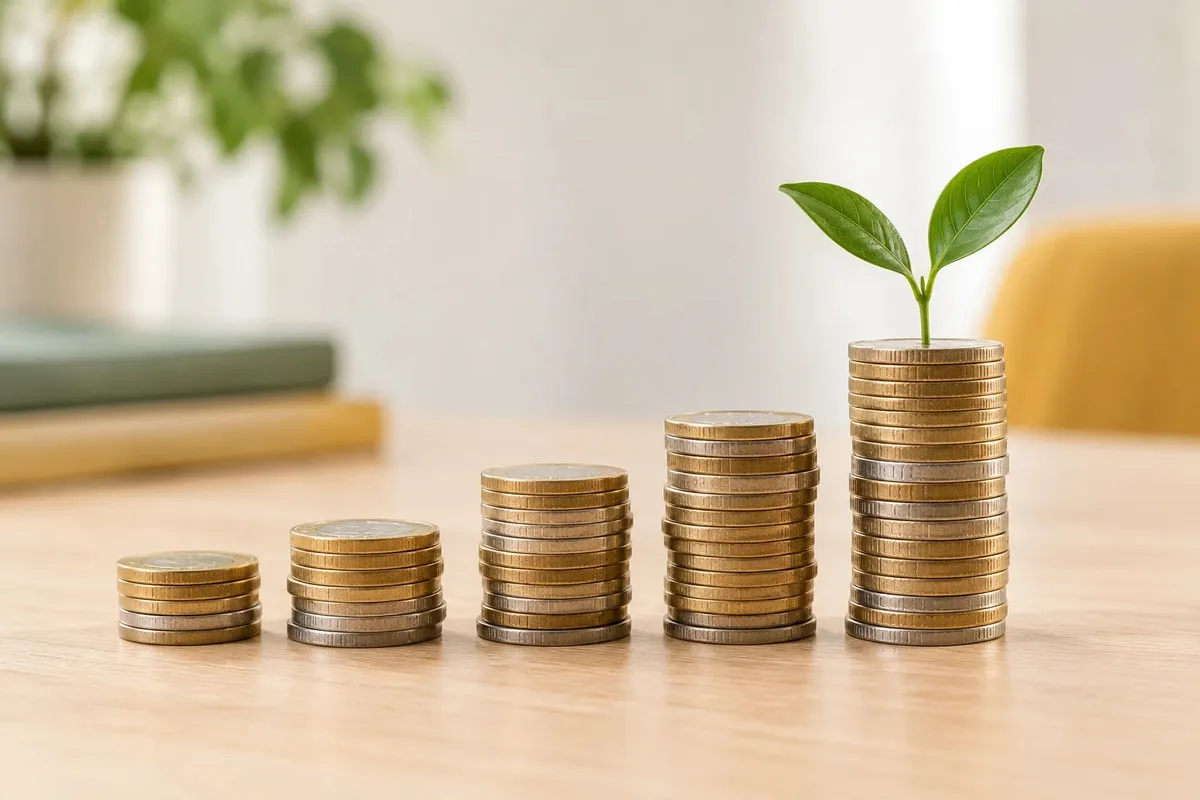
In The Price of Not Knowing we say that compound interest is the one concept in the book that, if you truly understand it at 20, changes the rest of your life mathematically. And it is almost never explained well: it is either taught as a cold formula, or course sellers use it as a promise of wealth.
It is neither. It is the unfair advantage of youth.
What it is, in one sentence
When you invest, your money generates a return. If you don't withdraw it, the following year both your initial money and the previous return generate a return. Interest on interest.
At first, the effect is barely noticeable. With enough time, it accelerates.
Example 1: the same contribution, ten years' difference
Two people invest €100 a month until age 65, with an average return of 6% a year. The only difference is when they start.
| Starts at 20 | Starts at 30 | |
|---|---|---|
| Years investing | 45 | 35 |
| Money contributed | €54,000 | €42,000 |
| Approximate final value | €275,600 | €142,500 |
The first person contributes only €12,000 more, but ends up with about €133,000 more. Those first ten years almost double the result, because they are the ones with the most time to compound.
Example 2: a single contribution, never touched again
You invest €1,000 just once and never contribute anything again, also at 6% a year.
- For 20 years: it becomes about €3,200.
- For 40 years: it becomes about €10,300.
Twice the time doesn't give twice the result: it gives more than triple.
What compound interest is not
Time doesn't work miracles with just any amount. If someone starts later but contributes much more each month, they can end up with more total money. Time doesn't replace amount: it multiplies it. That is why the practical conclusion is not "only starting early matters", but "don't wait until you have more to start", because every year that passes is compounding time that doesn't come back.
And three honest caveats about the examples above:
- A 6% annual return is a long-term average, not a guarantee. There will be years with sharp falls and years of gains. Past returns do not guarantee future ones.
- The figures are nominal. With inflation, the purchasing power of those euros in 45 years will be lower.
- Fees and taxes reduce the result. A high annual fee, kept for decades, eats a significant part of the compounding effect. That is why the book insists on diversified, low-cost instruments.
It's slow, and that's why it works
Compound interest is exactly the opposite of getting rich quick: it is slow, boring and works because it doesn't depend on one-off hits, but on not interrupting the process for many years.
In the book, Nora starts by investing an amount so small it seems almost symbolic. Three years later, when she reviews her account, she sees that part of what she has accumulated no longer comes from her contributions, but from the return on earlier returns. It wasn't a brilliant decision or a good market moment: it was not having stopped.
For most people who invest from a salary, contributing steadily and automatically works better than waiting for "the best moment" to put in a large amount. Nobody can predict that moment reliably, not even professionals.
Before investing, order matters
Investing is the last step, not the first. Before that, it is worth having:
- An emergency fund, so the first unexpected event doesn't force you to sell at a bad time. We explain how much you need and where to keep it.
- Expensive debts under control, because no prudent investment returns more than a revolving credit card debt costs.
- An automatic split system, like the 3 buckets, so the contribution leaves on its own every month.
Your Action Protocol (24 hours)
- Look for an online compound interest calculator and simulate three scenarios: €50, €100 and €200 a month for 20 years, at a conservative return.
- Compare how much of the result is money you put in and how much is return generated by earlier returns.
- Save a screenshot. It is the most convincing argument to start, even with a little.
The Price of Not Knowing devotes two chapters to compound interest and one more to opening your first investment account, step by step. All explained without jargon and without selling shortcuts.
This article is for informational purposes and does not constitute personalized financial advice. All investing involves risk, including the possible loss of the capital invested. The examples use a constant 6% annual return, with no fees, taxes or inflation. In example 1, contributions are monthly and interest compounds monthly; in example 2, interest compounds once a year.
 Save