
World Savings Day: how to start saving at 20 with the 3-bucket system

October 31 is World Savings Day. And almost all the advice that circulates that day has the same problem: it takes for granted that saving is a matter of willpower. Writing down every coffee, resisting every whim, checking your account every few days.
That method works for a few weeks. Then most people give it up.
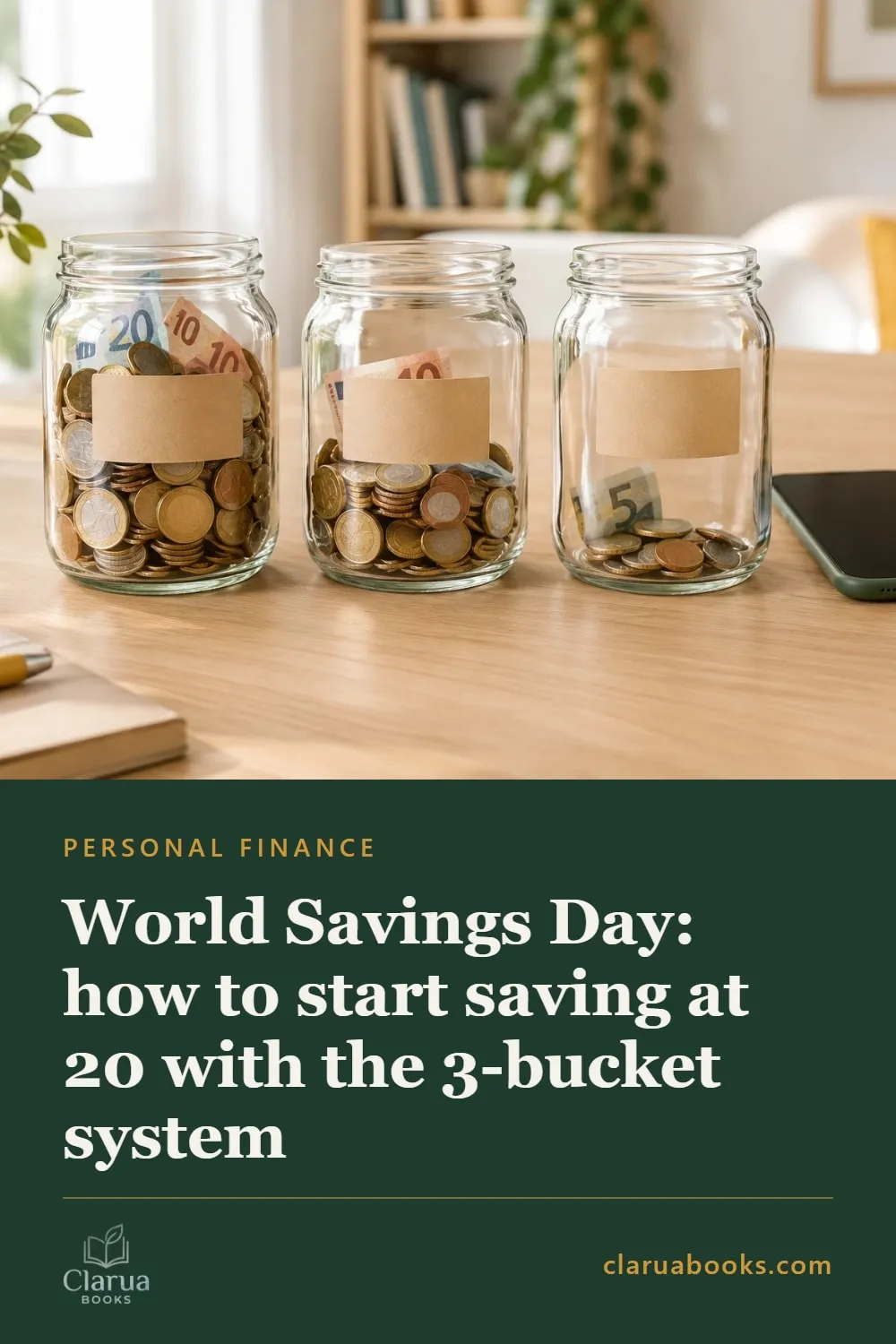
In The Price of Not Knowing we propose the opposite: instead of watching your money all the time, build a system once and let it run on its own. It is called the 3-bucket system.
First, an honest clarification
Dividing money into "buckets" with different purposes is not our invention. It is a technique known as bucket budgeting, which many financial planners have used for years. What the book does is adapt it to the priorities of someone starting from zero in their twenties.
The three buckets
1. The Shield bucket. Your emergency fund and the expenses that can't be negotiated: housing, insurance, debts. It is the one that protects you from chaos.
2. The Life bucket. Money to enjoy today without guilt: leisure, treats, experiences. It exists so that living is not just a profit-and-loss account.
3. The Freedom bucket. Your future: investing and long-term savings. It is the money that buys options for the person you will be ten years from now.
An important idea: all three buckets are filled at the same time, not one after another. You don't wait until the first is full to start on the others. Each month, each one gets its share from the first euro.
How much goes into each bucket
There is no correct split for everyone. As a reference for someone starting from zero, the book proposes:
| Stage | Shield | Life | Freedom |
|---|---|---|---|
| While you complete your emergency fund | 60% | 25% | 15% |
| With the emergency fund already complete | 20% | 30% | 50% |
These percentages apply to what is left after fixed expenses or to your total income, depending on how you prefer to organize yourself. What matters is not getting the exact figure right, but choosing a split you can sustain without feeling it suffocates you or that you are neglecting your future. If with your current salary you can only set aside 5%, start there.
The key: automation
The secret of the system is not in the percentages, but in this step:
On the same day you get paid, an automatic transfer splits the money among the three buckets.
That way, the money is divided before it has time to "feel like yours" in the checking account. There is nothing to decide each month and no willpower is needed. The system already decided for you when you were calm, not when you were watching an ad.
In the book, Nora discovers it this way: before setting up her buckets, she checked her account every few days and decided on the fly how much she could spend. It wasn't the amount of money that wore her out, but the number of repeated decisions. When she automated the split, she not only saved more: she stopped thinking about money almost every day, and she spent what was in the Life bucket without guilt, because she knew the other two were already covered.
How to set it up in 24 hours
- Define your starting split based on your real income and expenses.
- Open separate accounts or spaces for each bucket. Many banks and neobanks let you create "piggy banks", "vaults" or "spaces" within the same app, at no cost.
- Schedule a recurring transfer for the day you get paid.
After that, review it every few months. The split changes when you complete your emergency fund, when your income rises or when your priorities change.
What if I can't make it one month?
Adjust the percentages that month, giving priority to Shield over Freedom if you have to choose, and go back to the usual split as soon as you can. The system is there to serve you, not the other way around.
If your income is irregular, because you work on projects or as a freelancer, there is a useful adaptation: in good months, the surplus goes entirely to Shield until you have an extra cushion, and you draw from that cushion in lean months without touching the rest of the system.
Where to start
If you are only going to do one thing this Savings Day, make it creating your Shield bucket. We explain how much money you need in your emergency fund and where to keep it.
The Price of Not Knowing is a personal finance guide for young people who want to understand their money without jargon or promises of quick riches. Each chapter ends with a 24-hour Action Protocol to move from theory to practice, and includes templates for your cash flow and your buckets.
This article is for informational purposes and does not constitute personalized financial advice.
 Save