
Hierocles' circles: what they are and a classroom activity to work with them
Marc has received news he has kept to himself for days: he can apply to audition to study violin at a conservatory in the Netherlands. It's what he has always wanted. And yet what scares him most is not the audition, but what would come after: moving far away, without his family and without his friends.
In Talks on a Park Bench, it is Diego who answers him with an image from an almost unknown Stoic philosopher: Hierocles.
What Hierocles' circles are
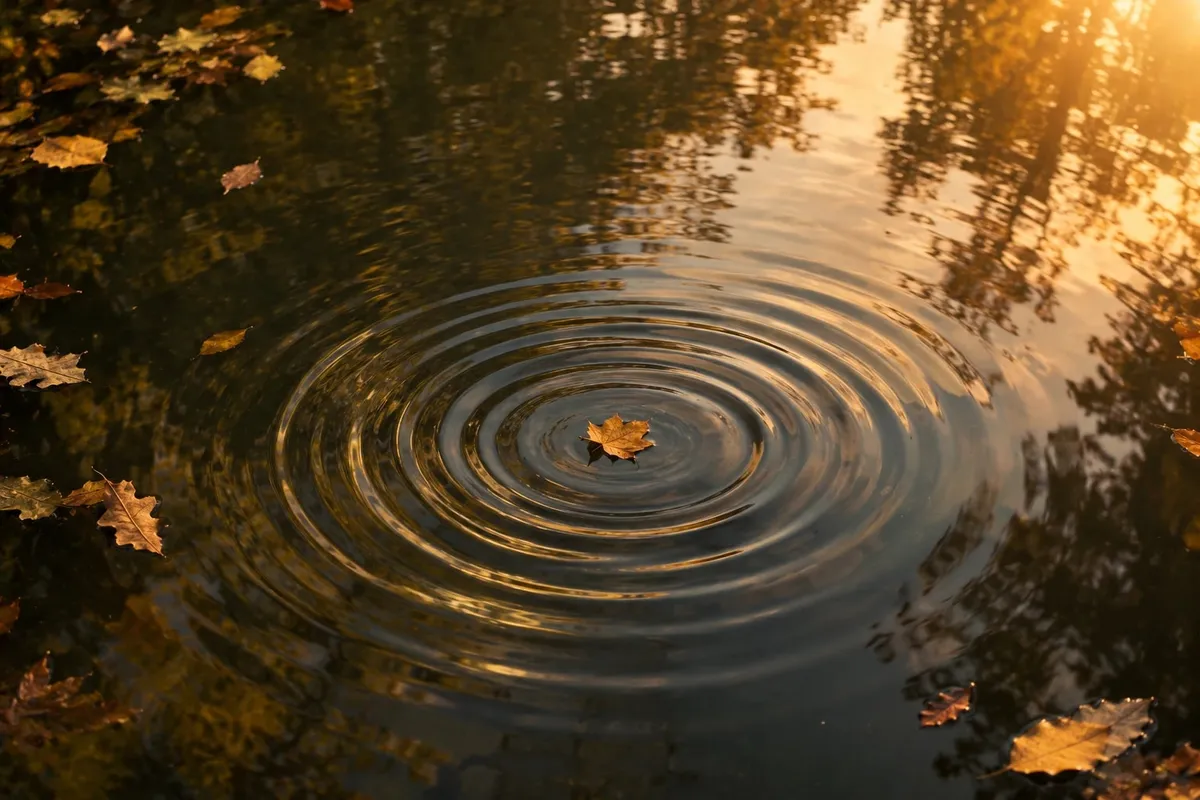
Hierocles lived in the 2nd century, and only fragments of his work have come down to us. But one of them contains one of the most influential images of Stoicism: each person lives surrounded by concentric circles, like the ripples that form in water.
- At the center, oneself.
- Around it, the closest family.
- Then, friends and more distant relatives.
- Beyond that, the community or the city.
- Further still, one's own country.
- And in the outermost circle, all of humanity.
Hierocles' proposal is not to stay in the smallest circle. It is just the opposite: to draw the distant circles toward the center, treating those who are farther away with a consideration similar to the one we give to those close to us.
Why it is a key idea
Hierocles' circles are the basis of Stoic cosmopolitanism: the conviction that all human beings share the same nature and deserve similar treatment, beyond borders and nationalities.
And they have a very current reading. The circles are not fixed. Someone who lives far away can stay in a close circle if the bond is looked after, and someone who lives a few meters away can end up in a very distant one through neglect. Belonging does not depend only on physical distance. Or, as Diego tells Marc: "Far is not the same as alone".
The book does not hide the limit of the idea: distance hurts, and no philosophical scheme replaces the presence of a loved one. The circles are not meant to minimize that pain, but to remind us that the bond does not have to break.
Classroom activity (50 minutes)
This proposal is designed for the 4th year of ESO (Spain's compulsory secondary education, ages 15–16), the 1st year of Bachillerato (ages 16–17, Philosophy) or Civic and Ethical Values education. It fits content on ethics, global citizenship and interpersonal relationships.
Objectives:
- Learn the image of Hierocles' circles and the concept of cosmopolitanism.
- Reflect on how we distribute our attention and our care.
- Debate the limits of the idea.
Materials: sheets of paper, colored pencils and, if you wish, the passage from chapter 3.2 of the book to read aloud.
1. Opening scene (10 minutes)
Read aloud Marc's situation: an opportunity that requires moving far away. Open question for the group: what would scare you more, the audition or what comes after? Why?
2. Explanation (10 minutes)
Present the six circles on the board and the idea of "drawing the circles closer". Introduce the term cosmopolitanism and its origin: the Cynic Diogenes, when asked where he came from, answered that he was a "citizen of the world" (kosmopolítēs).
3. A map of your own circles (15 minutes)
Each student draws their circles and places specific people from their life in them (they can use initials to protect privacy). Then they answer in writing:
- In which circle do you invest the most real time each week?
- Does it match the circle that matters most to you?
- Is there someone you have "pushed away" without meaning to?
4. Guided debate (15 minutes)
Some questions for discussion:
- Is it possible to treat a stranger like a friend? Is it desirable?
- Does it make sense to prioritize those closest to us, or does that contradict Hierocles?
- Do friendships that exist only through a screen count? In which circle would you place them?
- What about those who live next to you but are not part of your life, like a classmate you never talk to?
Homework: a gesture outward
For one week, each student makes a small gesture of attention toward someone they normally place in a distant circle: a message, a sincere question, a moment of real attention. In the next session, the experience is briefly discussed, on a voluntary basis.
More activities like this
This proposal is based on the exercises in the chapter "Hierocles' Circles" of Talks on a Park Bench, written by María Ferrer Tarazona, a high school philosophy teacher. Each chapter of the book follows the same structure: a scene among four friends, a philosopher's idea explained from scratch, its application to a young person's life, the objections to that idea and a box of practical exercises. That is why it works well as classroom reading: each chapter opens a debate and ends with material ready to work with.
Preparing activities for November 19? See our five activities for World Philosophy Day.
 Save