
Plato's allegory of the cave in the age of disinformation: how to step out of the shadows
From the book Talks on a Park Bench, by María Ferrer Tarazona
Diego has his phone in his hand and lets pass, almost on autopilot, a run of videos the algorithm has served him: discipline, getting up at dawn, motivational quotes. A year ago they would have seemed like absolute truth. Now he looks at them with different eyes and sums it up with an image that has been in his head all week: this is just the shadow of something much bigger, and a pretty distorted shadow at that.
The image is Plato's, it's more than two thousand four hundred years old, and it's at the center of one of the chapters of Talks on a Park Bench. There is probably no other philosophical idea that describes better how we get our information today.
What the allegory of the cave says
Plato tells it at the beginning of Book VII of the Republic, in a dialogue between Socrates and Glaucon:
- The prisoners. A group of people lives chained since childhood in a cave, always facing the back wall, unable to turn their heads.
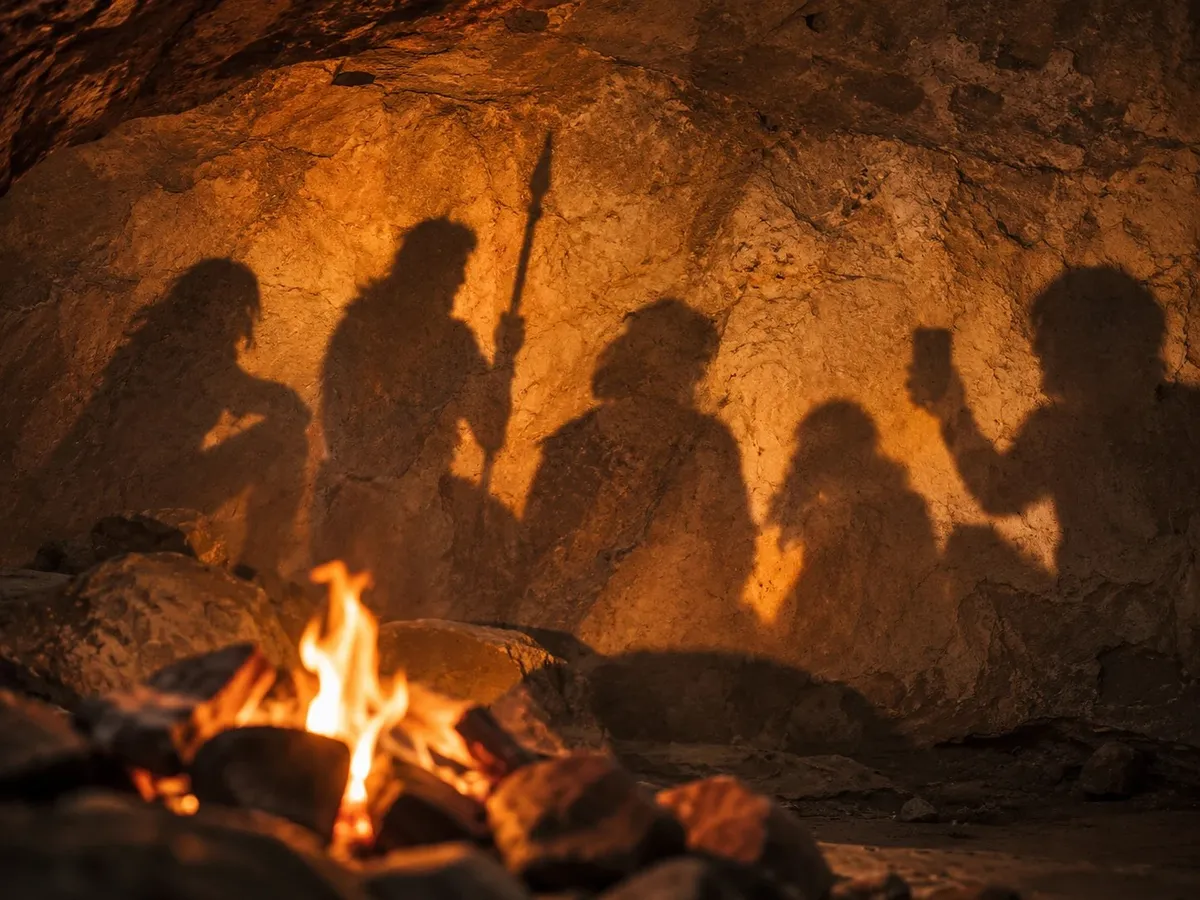
- The shadows. Behind them a fire burns, and between the fire and their backs other people carry objects and figures past. The prisoners only see their shadows projected on the wall, and since they have never seen anything else, they believe those shadows are the whole of reality.
- The way out. One of them manages to break free. He climbs with effort toward the exit, dazzled, seeing almost nothing at first. Gradually his eyes adjust and he discovers the real world: the trees, the water and, in the end, the sun itself.
- The return. He goes back down into the cave to tell the others and try to free them. But they don't believe him: they laugh at him, think he has gone mad and prefer their familiar shadows. Plato even says that, if they could, they would kill whoever tries to take them out of there.
What each element means
| Element | What it represents |
|---|---|
| The cave | The world of appearances, what we perceive without examining it |
| The shadows | Opinions, images and versions of things that we take for reality |
| The chains | The habits, prejudices and comforts that keep us from turning our heads |
| The climb | Education and philosophy: a slow, uncomfortable and sometimes painful road |
| The sun | Ultimate truth, what Plato called the Form of the Good |
| The rejected return | The resistance met by anyone who questions what everyone takes for granted |
Behind the allegory lies a distinction that runs through all of Plato's philosophy: the difference between doxa, opinion, what seems so to us without having examined it, and episteme, knowledge, what we know because we have given reasons. The shadows are the world of doxa. Leaving the cave doesn't consist of swapping some opinions for others, but of learning to ask why we believe what we believe.
Plato also gives it an educational and political meaning. For him, to educate isn't to stuff knowledge into an empty head, but to turn the person's gaze toward the light. And whoever has left has an obligation to go back down into the cave, however uncomfortable, because knowledge isn't worth much if it isn't shared with the community.
Many historians see in that ending a direct reference to Socrates, Plato's teacher, sentenced to death in Athens for questioning his city's established beliefs.
Why it's the best description of our screens
Plato didn't know social networks, but he described their mechanism with unsettling precision. Think about what each person sees when they open their phone: a wall of images selected for them, projected by someone they can't see.
In another chapter of the book, “The Algorithm and the Applause”, the characters discover that platforms aren't neutral: they're designed by teams of engineers and psychologists to capture our attention for as long as possible. And what captures the most attention usually isn't the most complete, but the most eye-catching: the fifteen-second clip, the outrageous headline, the sentence without context.
There's the updated cave:
- The fire and the objects are the real contents: a whole interview, a study, an event with all its nuances.
- The shadows are the cut-down version that reaches us.
- The chains are more comfortable than Plato's: nobody forces us to look, but infinite scrolling makes it very hard to turn our heads.
- And each person has their own wall. Two neighbors can spend the afternoon looking at completely different shadows of the same event and convince themselves that the other is living deceived.
That last point explains a good part of today's polarization: not only do we think differently, but very often we aren't even looking at the same wall.
Filter bubbles and echo chambers: the cave has a technical name
Two concepts help put present-day words to Plato's intuition:
- Filter bubble. The term was popularized by the activist Eli Pariser in 2011. Algorithms learn from what you look at, share and comment on, and show you more and more of the same. Without you deciding it, your wall gradually fills with the shadows you already liked.
- Echo chamber. It happens when we surround ourselves, on social media or in real life, with people who think like us. The same ideas bounce back and get amplified, and opposing ones barely arrive, or arrive in their most caricatured version.
Researchers are still debating how much exactly algorithms weigh against our own choices: we're also the ones who follow, mute and share. But the effect they describe is that of the cave: a partial view that feels complete.
Disinformation isn't always a lie
It's worth distinguishing three things that we usually lump together:
| Type | What it is | Example |
|---|---|---|
| False information | Something that isn't true | An invented quote attributed to a public figure |
| Information taken out of context | Something true, but cut down or presented misleadingly | Fifteen seconds of an hour-long interview |
| True but selective information | Real facts, chosen so that only one part is seen | Showing only the data that supports a conclusion |
The last two are the most effective, precisely because they aren't lies. They're shadows: real silhouettes of real objects, but with no volume, no color and without what's left outside the frame. Plato already knew it: the prisoners don't see invented illusions, but shadows of things that exist.
The trap of the freed prisoner
The chapter in Talks makes a warning that's worth not skipping, because it's where almost everyone goes wrong: the allegory of the cave isn't for feeling superior.
It's very tempting to read it that way: I'm the one who has gotten out and the others are still looking at shadows. But that reading turns philosophy into another form of arrogance. The reality is more uncomfortable: all of us live, at different moments and on different subjects, settled in some reduced version of reality without knowing it.
The honest attitude isn't “I'm already outside”, but to keep always open the suspicion that, in some area of one's own life, there is still some shadow left to discover. This applies to anyone, whatever they think, and it's precisely what allows you to talk with someone who sees another wall without despising them.
How to leave the cave (a little every day)
Fact-checking professionals don't read a piece of information from top to bottom to decide whether it's reliable. They do what's called lateral reading: they open other tabs and check what others say about that source and that claim. The researcher Mike Caulfield summed it up in a four-step method widely used in education, known by its acronym, SIFT:
- Stop. If something provokes a strong emotion in you (outrage, fear, euphoria), that's the moment not to share yet.
- Investigate the source. Who is publishing it? What do you know about that person or outlet? Look it up outside its own page.
- Find other coverage. Do other reliable outlets report it, including some that usually think differently? If nobody else picks it up, be wary.
- Trace it to the original. Go back to the primary source: the full video, the study, the whole statement. Many shadows dissolve on their own when you see the object.
And one more question, the most Platonic one: does it dazzle me or does it confirm me? Leaving the cave is a little uncomfortable. If something fits too well with what you already thought, it's worth looking at twice. Psychologists call it confirmation bias: the tendency to believe more easily what reinforces our prior ideas.
Descartes' methodical doubt takes this idea a step further: we cover it in doubt before you opine: skepticism as an antidote to fanaticism.
Classroom activity (50 minutes)
For 4th year of ESO (ages 15–16) and Bachillerato (ages 16–18), in Philosophy or Civic and Ethical Values Education.
1. Reading and drawing (15 minutes). Read aloud the passage from Book VII of the Republic or a summary. In pairs, students draw the cave and label each element: prisoners, wall, fire, figures, exit, sun.
2. Today's cave (15 minutes). Each pair transfers the drawing to their digital life: what would the wall be? Who moves the figures? What would the chains be? They share on the board.
3. Shadow and object (15 minutes). The teacher shows an invented news story in two versions: a short, eye-catching headline, and the full text with nuances. First only the headline is read and each person writes their opinion; then, the whole text. Has anything changed? Why was the headline more “shareable”?
4. Closing (5 minutes). Open question, no right answer: On what subject do you suspect you are still looking at shadows?
For home: “today's shadow”. It's one of the chapter's exercises. Choose a topic on which you suspect you only know the superficial, viral version (a news story, an idea, a public figure) and look into a bit more context before taking it as understood.
Frequently asked questions
What does Plato's allegory of the cave say?
Prisoners, chained since childhood in a cave, can only look at a wall on which the shadows of objects lit by a fire behind them are projected. They believe those shadows are all of reality. One of them breaks free, goes outside and discovers the real world; when he returns to tell the others, they don't believe him and reject him.
What does the allegory of the cave mean?
It represents the passage from ignorance to knowledge. The cave and the shadows symbolize the world of appearances and unexamined opinions; the way out, the effort of education and philosophy; and the sun, ultimate truth, what Plato called the Form of the Good.
In which work does the allegory of the cave appear?
In Plato's Republic, at the beginning of Book VII, written in the 4th century BC in the form of a dialogue between Socrates and Glaucon.
What does the allegory of the cave have to do with today?
It is often used to think about algorithms and social networks: each person sees a selection of images and fragments designed to capture their attention, and may take it for the whole of reality. The lesson is not to feel outside the cave, but to suspect that all of us have some shadow left to discover.
Beyond the cave
The allegory of the cave is the image that runs, without being named, through all of Talks on a Park Bench: the distance between the thirty-second version of an idea and the whole idea. It begins with the Stoicism sold on Instagram, which we cover in what Instagram doesn't tell you about Stoicism, and ends much further away.
Are you a teacher? This article is part of the free lesson unit Thinking About Democracy, with six lessons, worksheets and a rubric.
Talks on a Park Bench, by philosophy teacher María Ferrer Tarazona, follows Marc, Nora, Diego and Vera as they stumble, without looking for it, on the same questions philosophers have been asking for more than two thousand years. With practical exercises at the end of each chapter, it's a read meant for young people and also for the classroom.