
Black Friday: how they use psychology to make you buy things you don't need
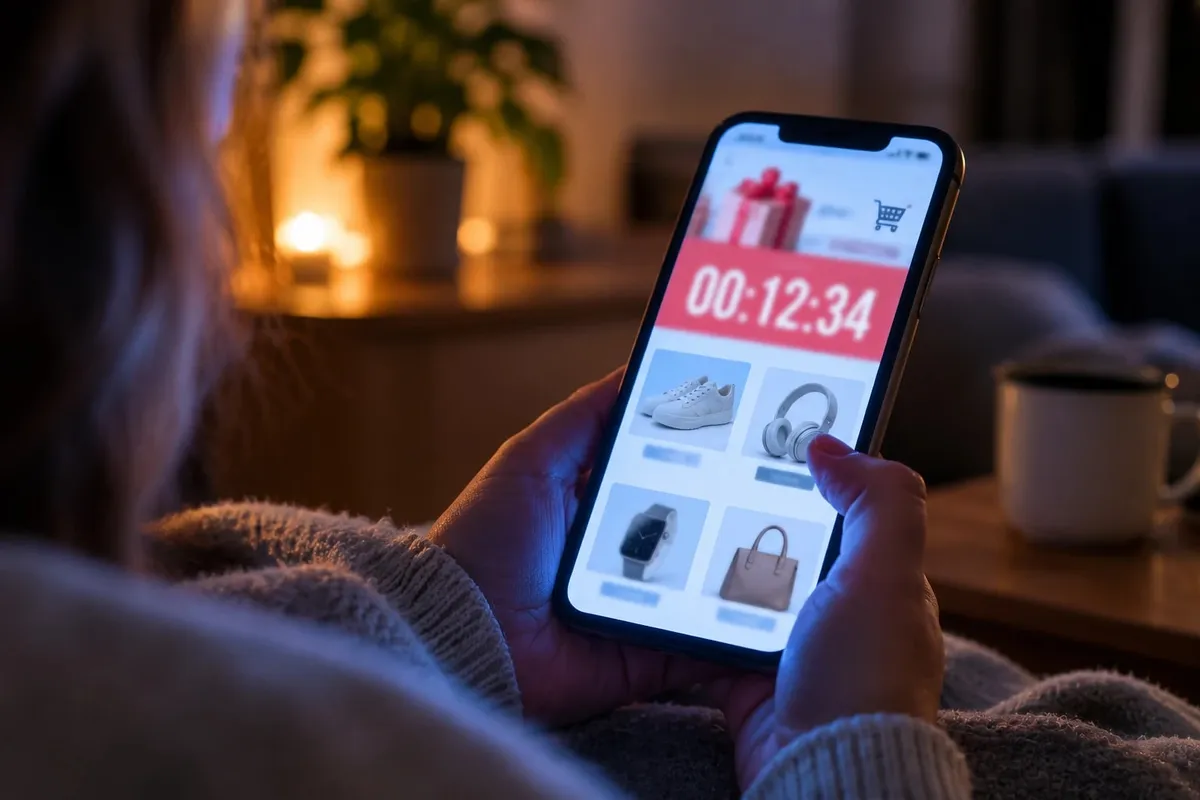
It's half past eleven at night. You're in bed looking at your phone and a notification pops up: "Today only: -40%. 3 units left". Below it, a countdown. You open the app and, without quite knowing how, ten minutes later you have in your cart a pair of sneakers you didn't need, a speaker you already own in another colour and a pack of something "just in case".
It isn't a lack of character. It's that Black Friday is designed, down to the millimetre, to make you buy without thinking. And once you understand how the trick works, it loses much of its power.
This year, Black Friday falls on Friday, 27 November, although many shops stretch the "deals" over weeks.
Download the free Black Friday anti-impulse list (PDF) ↓
The 6 psychological tricks of Black Friday
1. Artificial urgency: the countdown
"Ends in 02:14:37". A countdown doesn't give you information: it takes away time to think. When the brain senses that an opportunity is running out, it switches to reaction mode and stops comparing, calculating and asking whether you really need it. And many of those "deals that end today" come back on Monday under another name: Cyber Monday, Black Week, extended offers…
2. Scarcity: "only a few left"
What seems scarce seems more valuable to us. Warnings like "only 2 left" or "12 people are looking at this product" trigger the fear of missing out, even though five minutes ago you didn't know it existed. That fear of being left out has a name: FOMO (fear of missing out).
3. The anchor price and inflated discounts
If you see "€199 €99", your brain keeps the first number as a reference and feels it is gaining €100. But did anyone really pay €199 for that product? The crossed-out price is there so that the second one looks like a bargain.
The good news is that in Spain the law protects against this trick: when a shop advertises a discount, the previous price it shows must be the lowest one it applied in the previous 30 days. Spain's Ministry of Consumer Affairs watches precisely for prices that go up weeks before Black Friday only to be "reduced". If you live elsewhere, check the rules where you are, because they may differ.
4. "Pay in 3 instalments, interest-free"
Splitting a payment doesn't change what it costs, but it does change what it feels like it costs. Forty euros a month hurts less than a hundred and twenty at once, which is why these options appear right next to the pay button. The problem comes when you pile up several deferred purchases across different apps and none of them shows you the total. We explain it in depth in "Buy now, pay later": the debt that doesn't feel like debt.
5. Frictionless buying
Saved card, one-click or fingerprint payment, free shipping above a certain amount… Shops have spent years cutting the time between impulse and payment to almost zero. Every second they remove is one less second for you to ask whether you really want it.
6. The algorithm that picks the moment
Notifications don't arrive at random. Apps learn when you are most vulnerable: late at night, after a bad day, when you've been scrolling for a while. They don't show you only what interests you; they show it to you when you are most likely to buy.
Why they work even if you "already know"
Knowing these tricks exist doesn't make you immune. They work because they exploit mental shortcuts we all have:
- Loss aversion: missing an opportunity hurts us more than gaining something equivalent pleases us.
- Social proof: if lots of people are buying it, it must be a good idea.
- Present bias: the pleasure of buying is now; the cost arrives at the end of the month.
- Decision fatigue: after comparing twenty products, the brain picks the easiest option, which is usually to buy.
That is why the solution is not "resisting better" in the moment, but deciding beforehand, with a cool head.
Your anti-impulse plan for Black Friday
Before: make the list and set a limit
- Write down what you need before you see any deal. If it isn't on the list, you don't buy it this Friday.
- Set a maximum budget for the whole day, not for each purchase. If you use the 3-bucket system, that money comes out of your Life bucket, never from your emergency fund or your savings.
- Check today the prices of what is on your list. That way you'll know on Friday whether the discount is real.
During: add friction on purpose
- Delete your saved card from the apps where you buy most on impulse. Álex, one of the main characters of the book, discovered he had it saved in eleven apps. When he removed it from almost all of them, several times he abandoned the cart simply because he had to type in the numbers.
- Turn off shop notifications for that week.
- Apply the 72-hour rule: any non-essential purchase above an amount you decide (for example, €50) waits three days. If it's a real deal on something you really want, it will still make sense.
- Ask yourself just one question before paying: would I buy it if I had to pay for it in full today? If the answer is no, that "no" is the information you need.
After: review without guilt
- Use your right of withdrawal if you got it wrong. For online purchases within the EU you have 14 days to return without giving a reason, with some exceptions.
- Write down what you spent and compare it with your limit. Not to punish yourself, but to have a real figure for next year.
How to check whether a discount is real
- Look at the previous price the shop shows: it must be the lowest of the last 30 days.
- Check the price history with a comparison site or a price-tracking browser extension.
- Compare in two or three shops before deciding.
- Be wary of huge percentages from brands you don't know, and even more if the site only accepts bank transfer or advance payment: always pay with a method that lets you file a claim.
It's not about buying nothing
Black Friday can be a good time to buy something you had already decided to buy and had been waiting for. The problem is not the deal: it's buying things that weren't in your plans because someone designed the perfect moment for you to do it.
The difference is who decides: you, with the list made and the limit set, or the countdown.
Download the free anti-impulse list
We've prepared a Black Friday anti-impulse list: a page to print or keep on your phone, with your list of needs, your maximum budget and the five questions worth asking before paying.
Download the anti-impulse list (PDF) ↓
Frequently asked questions
How can I tell if a Black Friday discount is real?
In Spain, when a shop advertises a discount it must show as the previous price the lowest one it applied in the previous 30 days. You can also check the product's price history on comparison sites and tracking extensions. If the price went up weeks earlier only to be "reduced", the discount is misleading.
Can I return what I buy on Black Friday?
If you buy at a distance (online or by phone) within the European Union, you have 14 days to withdraw without giving a reason, with some exceptions such as tickets or personalised products. In a physical shop, returns depend on each shop's policy, unless the product is faulty.
What is the 72-hour rule?
It means waiting 72 hours before making any non-essential purchase above an amount you decide, for example €50. Most impulses don't survive three days; real wishes do.
Is paying in instalments on Black Friday a bad idea?
Not always, but deferred payment lowers the feeling of spending and makes it easier to buy more. If you wouldn't buy it paying in full today, that is a sign you can't afford it right now.
Going further
The Price of Not Knowing is a personal finance guide for young people that explains, without jargon or promises of quick riches, how the mechanisms that decide for you what you spend your money on work: the algorithm, FOMO, deferred payment or lifestyle inflation. Each chapter ends with a 24-hour Action Protocol to move from theory to practice.
And if Black Friday finds you with December's budget on your mind, continue with our guide to Christmas and money: how to enjoy it without the pressure to spend.
This article is educational and does not constitute personalised financial or legal advice.